Cherry Creek Neighborhood
Denver's most prestigious address — world-class shopping, exceptional dining, luxury real estate, and the Cherry Creek Trail, in the heart of the city.
Neighborhood Spotlight
Cherry Creek is, by almost any measure, Denver's premier neighborhood. Home to Denver's most expensive zip code (80206), it sits just 10–15 minutes southeast of downtown and packs a remarkable amount into a relatively compact footprint: over 300 stores and galleries, some of the city's best restaurants, luxury hotels, direct access to one of Colorado's great urban trails, and a residential side that blends original 1920s charm with contemporary new-builds worth millions. Sam calls it "perhaps the nicest neighborhood in the entire city" — and it's hard to argue.
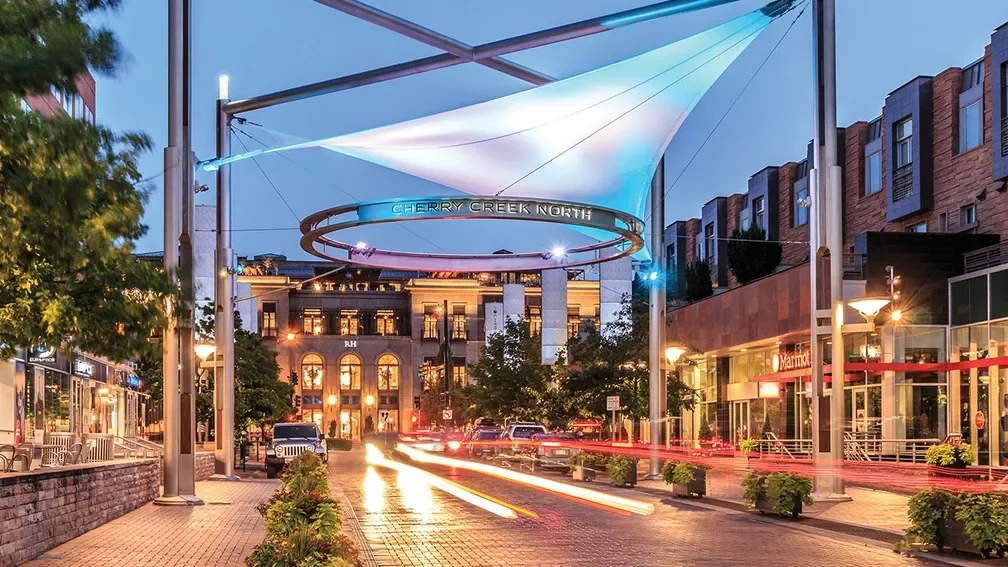
The neighborhood divides naturally into two zones. Cherry Creek North is the famous open-air shopping and dining district — 16 walkable, tree-lined blocks roughly bounded by University Boulevard, Steele Street, 1st Avenue, and 3rd Avenue. Think curated boutiques, art galleries, outstanding restaurants, the Cherry Creek Farmers Market, and some of Denver's most stylish foot traffic. On the other side of 1st Avenue sits the Cherry Creek Shopping Center, one of the finest enclosed malls in the region, anchored by Nordstrom, Neiman Marcus, and Macy's, with Louis Vuitton, Tiffany & Co., Burberry, and dozens of luxury brands filling the rest.
The residential streets north of 3rd Avenue are some of the most coveted in all of Denver. Wide, quiet, tree-canopied blocks lined with Tudors, Colonial Revivals, brick ranches, and sleek contemporary new-builds create a neighborhood feel that somehow coexists with the commercial pulse just steps away. It's urban where things are happening — but quiet and welcoming rather than overwhelming.
The Neighborhood and Location
Cherry Creek is bordered by University Boulevard to the west, 6th Avenue to the north, Colorado Boulevard to the east, and Alameda Avenue to the south. Adjacent neighborhoods include Congress Park to the north, Hilltop to the east, Bonnie Brae and Belcaro to the south, and Washington Park to the west — all of them strong in their own right, which helps explain the demand here.
The namesake Cherry Creek runs along the neighborhood's southern edge, and the Cherry Creek Trail — a 42-mile paved path that stretches from Confluence Park (where it meets the South Platte River) all the way southeast to Cherry Creek State Park and on to Franktown — follows it. For cyclists and runners, this is one of the great urban trail networks in America: car-free, scenic, and genuinely useful for commuting. Downtown is about 3 miles via the trail, making it a legitimate option for bike commuters.
By car, downtown is 10–15 minutes without traffic. I-25 is 5 minutes west, and the Denver Tech Center is about 20 minutes south. Colorado Station is reachable by bike or bus, connecting the neighborhood to downtown, Union Station, Denver International Airport (via transfer at Union Station), and the southeast suburbs.
Walkability, Lifestyle, and Amenities
Cherry Creek earns some of the highest walk scores in the Denver metro. Within a few blocks of the core, residents can handle groceries (Whole Foods on 2nd Avenue), dining, fitness, personal services, and shopping entirely on foot. Add the Cherry Creek Trail for car-free commuting and recreation, and this is genuinely one of the few Denver neighborhoods where a car-light lifestyle is not just possible but comfortable.
The dining scene is exceptional and wide-ranging. Elway's — the legendary steakhouse from Broncos icon John Elway — remains one of Denver's premier power-lunch and dinner destinations. Quality Italian brings handmade pasta and a lively atmosphere. Machete Tequila + Tacos offers upscale Mexican with creative cocktails. And the Cherry Cricket, serving legendary burgers since 1945, is an oasis of no-frills, beloved normalcy in an otherwise upscale neighborhood. Sam's personal favorite is Blue Island Oyster Bar: great oysters, great drinks, and perhaps the best happy hour in all of Denver.
For hotels, Cherry Creek is one of Denver's top destinations. The Halcyon is a boutique hotel with a rooftop bar (Kisbee on the Roof) that draws residents and visitors alike. The Jacquard brings understated luxury to the neighborhood, and Hotel Clio (a Luxury Collection property) rounds out Cherry Creek's impressive hotel roster.
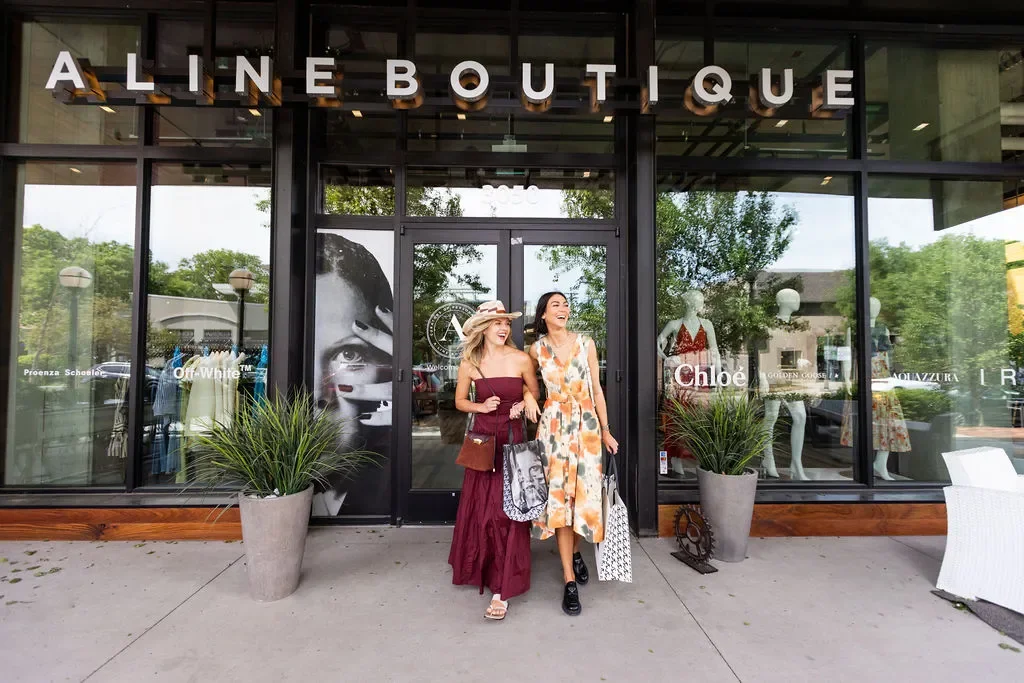
The shopping speaks for itself. Cherry Creek North's 16 blocks are lined with independent boutiques, specialty shops, art galleries, jewelers, and home goods stores — a curated mix you won't find in any other Denver neighborhood. Across 1st Avenue, the Cherry Creek Shopping Center adds Nordstrom, Neiman Marcus, and more than a dozen flagship luxury brands. It's a complete retail ecosystem in a walkable area — a rare thing anywhere, let alone in Colorado.
Community life here is active. The Cherry Creek Arts Festival, held annually on the July 4th weekend, is one of the top juried art festivals in the country, drawing hundreds of thousands of visitors over three days. The Saturday Cherry Creek Farmers Market runs from spring through fall. Boutique fitness studios — CorePower Yoga, Orangetheory, Life Time, Pilates, cycling — are woven throughout the neighborhood.
Cherry Creek Real Estate: Prices, Trends, and Types of Homes
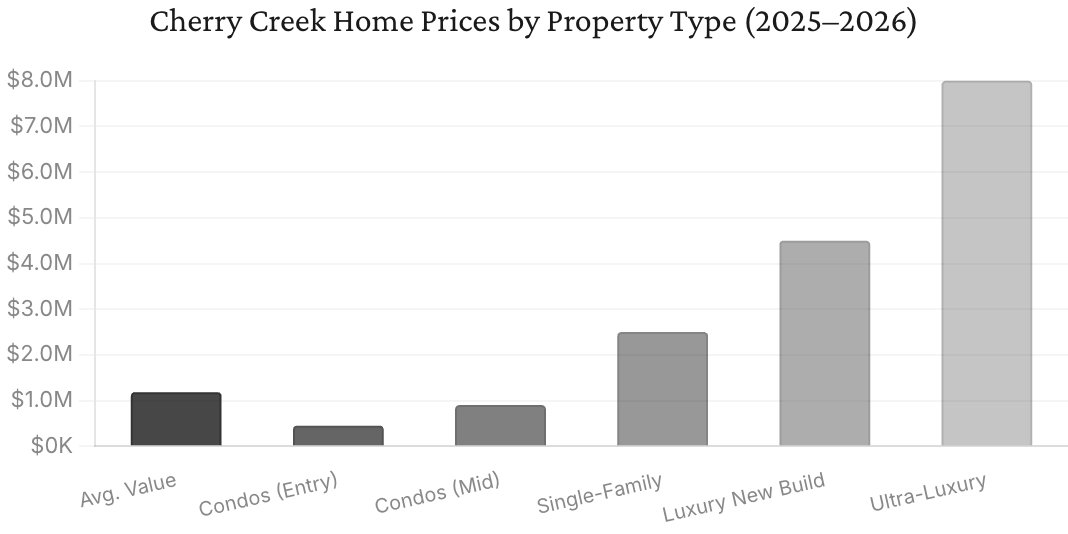
Cherry Creek is Denver's most expensive neighborhood, and the market reflects it at every price point. Here's the current picture:
Average Home Value: $1,183,052 (down 1.9% year-over-year)
Median Listing Price: $1,500,000
Condos and Townhomes: $450,000–$1.2 million (entry from mid-$400Ks)
Single-Family Homes: $1.2 million–$4 million+
Luxury New Construction: $2.5 million–$6 million+
Luxury Condo Average Sale Price: $1.72 million; penthouses $5.5 million+
Ultra-Luxury Estates: $8 million+ (a Laurel Cherry Creek penthouse sold for $10.1M in Oct 2025)
Average Days on Market: 21 days
Market Supply: 1.9 months (strong seller's market)
HOA Fees (luxury buildings): $900–$2,800+/month
Long-Term Appreciation: ~6.5% annually since 2021
The housing stock is remarkably varied for a neighborhood this small. On the north side of Cherry Creek, you'll find original 1920s–1940s Tudors and Colonial Revivals with brick construction, arched doorways, and classic Denver Square layouts — many of them meticulously renovated. Mid-century brick ranches from the 1950s and 1960s are common too, ranging from tastefully preserved originals to full teardowns replaced by contemporary builds. New construction leans toward modern farmhouse or minimalist contemporary — typically 3,500–5,000+ sq ft on 6,000–8,000 sq ft lots, priced between $2.5M and $6M.
On the east side closer to Colorado Boulevard and in Cherry Creek East, the density increases. Townhomes and duplexes here are typically priced from $1 million to $1.5 million — a relative discount compared to the Cherry Creek North prime pocket — with larger floor plans of 3,000–4,000 sq ft. Condos span the full spectrum, from $450K studios to $1.2M two-bedroom units in mid-rise buildings, up to $10M+ penthouses in trophy developments like The Laurel and the forthcoming Waldorf Astoria Residences.
The pace of the market is fast. With just 1.9 months of supply and a median of 21 days on market, desirable homes move quickly — especially in spring and summer. If you're buying here, be prepared to act decisively.
Benefits of Living in Cherry Creek
Denver's Best Shopping and Dining — Walkable
No other Denver neighborhood puts this volume and quality of retail, dining, and services within walking distance. Cherry Creek North's 16-block district and the Cherry Creek Shopping Center together represent over 400 shops, galleries, and restaurants. Whether it's a spontaneous weekday dinner at North Italia, a Saturday morning farmers market, or browsing independent galleries on a Sunday afternoon, Cherry Creek delivers a lifestyle that most Denver neighborhoods simply can't replicate on foot.
Cherry Creek Trail Access
Direct access to the 42-mile Cherry Creek Trail is a major asset. The trail runs from the neighborhood's southern edge all the way to Cherry Creek State Park, and connects to the South Platte River Trail at Confluence Park near downtown. It's a car-free commute corridor, a recreational spine, and one of the best urban trails in the western U.S. — and Cherry Creek residents have it right at their doorstep.
Strong, Resilient Property Values
Cherry Creek has averaged approximately 6.5% annual appreciation since 2021, outperforming the broader Denver metro consistently. With critically low inventory, a seller's market, and a "blue-chip" reputation that draws buyers from across the country, Cherry Creek real estate holds its value better than almost anywhere in Colorado. Even in softer markets, Cherry Creek tends to be the last neighborhood to decline and the first to recover.
Central Location with Everything Nearby
Downtown is 10–15 minutes away. Washington Park is a short bike ride to the west. Hilltop and Congress Park are right next door. I-25 and the Denver Tech Center are quick commutes to the south. And for those who need to get to DIA, Union Station is accessible via light rail from Colorado Station, making even airport trips manageable without a car.
Drawbacks and Considerations
Denver's Highest Price Tags
There's no sugarcoating it: Cherry Creek is the most expensive neighborhood in Denver. The entry point for a condo is around $450K–$500K, single-family homes start above $1.2 million, and prime properties near Cherry Creek North routinely trade between $2.5M and $6M. HOA fees in luxury buildings add $900–$2,800+ per month on top of mortgage costs. For many buyers — especially first-timers — Cherry Creek is something to aspire to rather than a realistic near-term option.
Traffic and Parking Frustrations
Cherry Creek's desirability creates real congestion. Colorado Boulevard and University Boulevard — the neighborhood's eastern and western borders — are among Denver's busiest arterials. During holidays, shopping season, and the Cherry Creek Arts Festival, traffic backs up significantly. Street parking in Cherry Creek North is notoriously competitive on weekends, and even private garages fill during peak events. Residents who rely on a car for daily errands will want off-street parking built into their housing arrangement.
School District Nuance
Despite what many assume, the Cherry Creek neighborhood is zoned to Denver Public Schools (DPS) — not the Cherry Creek School District, which serves suburban communities like Greenwood Village, Centennial, and parts of Aurora. DPS schools in the area include Bromwell Elementary and George Washington High School. Families prioritizing the Cherry Creek School District specifically would need to look further south or east. That said, several strong private schools — Graland Country Day School, Kent Denver — are within a short commute.
Things to Do in Cherry Creek
Eat and Drink: Grab oysters and Denver's best happy hour at Blue Island Oyster Bar, a legendary burger at Cherry Cricket (a Denver institution since 1945), prime steak at 801 Chophouse, upscale Mexican at Machete Tequila + Tacos, handmade pasta at Quality Italian, or a no-frills beer at the Milwaukee Street Tavern. Hapa Sushi is a neighborhood standout for Japanese.
Shop Cherry Creek North: Spend an afternoon browsing 16 blocks of independent boutiques, galleries, specialty shops, jewelers, and home goods stores — Denver's most curated retail district. Whole Foods anchors the everyday end, while one-of-a-kind boutiques and galleries define the character. The Saturday Farmers Market (spring through fall) is a neighborhood ritual.
Cherry Creek Trail: Run, bike, or walk the 42-mile trail from the neighborhood's southern edge all the way to Cherry Creek State Park — or head northwest toward downtown and the confluence of the South Platte River. It's one of Colorado's great urban trail networks, and Cherry Creek's front door opens right onto it.
Cherry Creek Arts Festival: Held annually on the July 4th weekend, this nationally recognized juried art festival draws hundreds of thousands of visitors over three days, with hundreds of artists, live music, food, and interactive programming. It's one of the top art festivals in the country — and it happens right in the neighborhood.